Saturday, March 23, 2013

Electricity & Magnetic Fields (Standard 6.1)

How is electricity generated by moving magnetic fields?

From our electrostatics unit, we know that electricity can be defined as simply as the movement and transfer of electrons. we also know that certain magnets repel and attract due to a magnetic field (B). A magnetic field exerts a force on moving charges. Also, any moving charge has a magnetic field that surrounds it. In the photo below, a horse shoe magnet is underneath a piece of paper in which we sprinkled powdered iron onto. The lines show the magnetic field:


The magnetic field that surrounds a magnet applies a force to the electrons in an object which causes them to flow, or an increase in current. This increase in current results in more electricity.

Saturday, February 9, 2013

Electrostatics... Zappppp!


The biggest idea of electrostatics is the idea that whether an object is positive, negative, or neutral is a matter of the object's movement of it's electrons. Protons never move, but charge is based on the movement of electrons. Similarly to what we already know about energy, electrons are not created or destroyed, just transferred. Something that really surprised me was the definition of what a neutral object is. A neutral object just has a balanced amount of electrons and protons rather than nothing at all. But this does not mean that a neutral object can't react with another object. As our class saw when we put a plastic comb that had gained a charge from the friction created by brushing hair, next to a stream of water. We saw the following result:

Why does the water seem to move towards the comb? 
Because (let's say) the electrons in the comb begin to react with the protons in the water. This results in the opposite charges of the two object to repel each other which makes the protons and electrons polarize, or separate from each other. 

Can a neutral and a charged object ever have a repelling force?
NO because protons and neutrons will always polarize in such a way that creates an attractive force (since only the electrons move). Either electrons are being pushed away, or being pulled towards a charged object. 


Now that we understand charge, what is voltage? And how do we give charges energy, like when we "charge" a battery?

Voltage can also be referred to as Electrical Potential Energy. Lets think back to when we studied Gravitational Potential Energy (Ug). An object had potential energy when it was at a height above the earth. This makes sense because if an object is lets say on top of a cliff, it has POTENTIAL to fall off the cliff and plummet towards the ground. Same idea with voltage. Voltage gives charged objects a distance between eachother. All voltage is is building a (hypothetical) mountain of energy that gets transferred into other things. VOltage puts charges in such a place that stores energy. 

Helpful analogy: What voltage does for charge is the same as what height does for Potential energy.

Greater voltage or charge means a greater electrical potential energy.

The greater the height or mass of an object means a greater Ug.

Potentia So when we plug in our ipads before we go to bed and it only has about 14% left, we plug our charger into the ipad, and the charger into some sort of wall outlet. The wall outlet only provides a certain amount of Voltage for objects. In the U.S, it is about 120V. 120V would be too much for our little iPads, so the charger only uses about 5.1V for charging. This wall outlet provides a height, or a distance between charges. Yes they are neutral, but their job is to separate charges in such a way that creates a charge.

But what determines if an ipad or any other device charges quickly or not? Whats the difference between the energy a lithium battery we put in our remote controls provides from a fancy white iPhone charger? Check this article out for more information on the advancement of our Electric Potential Energy!
A brief discourse on batteries (and the new iPad!)

Thursday, January 24, 2013

Projectile Motion

Description of Lab:
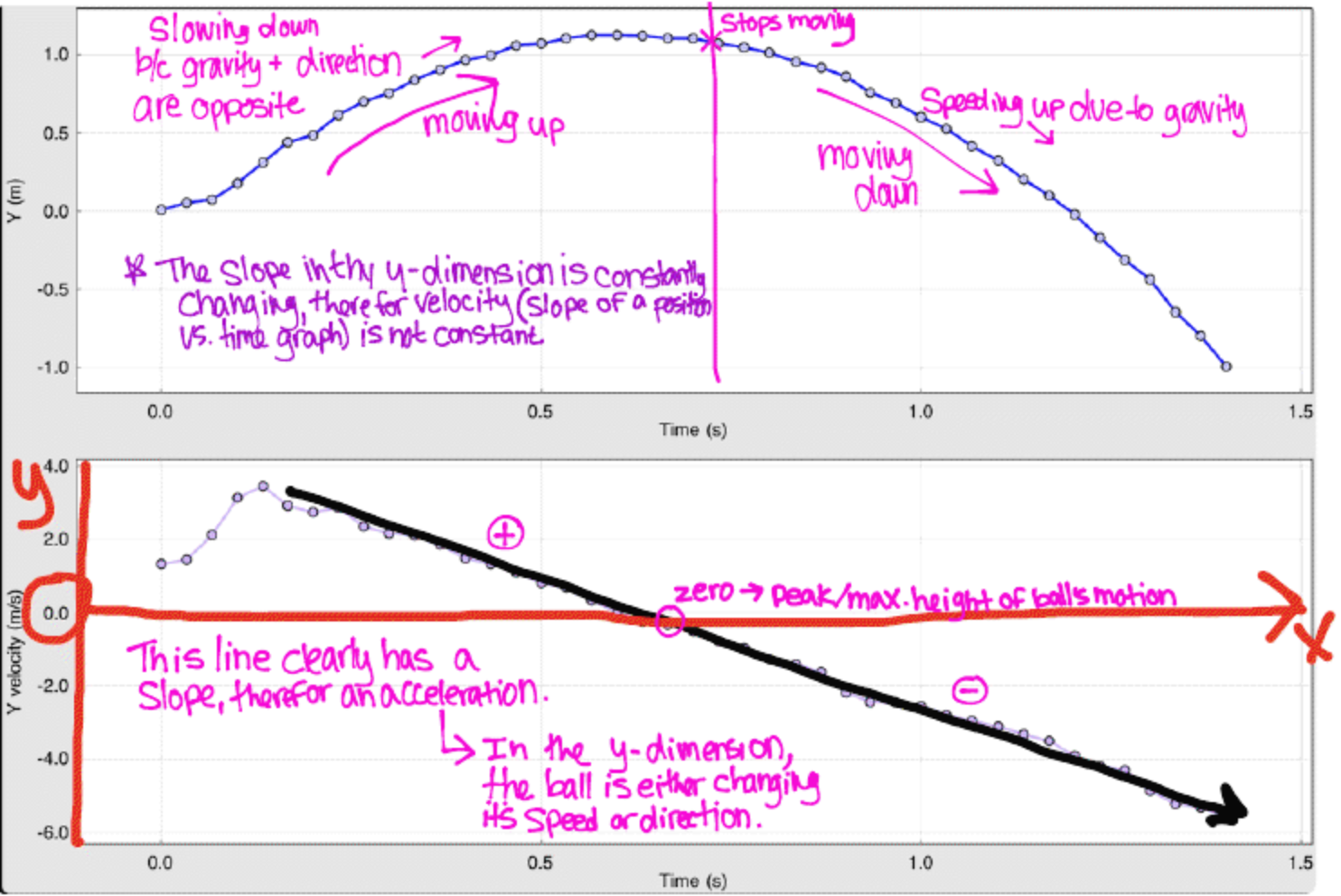
-In this week's lab, we analyzed the motion of a basketball when it is thrown in the air and moves from left to right, up and down. We used the apps Video Physics and Graphical Analysis to record the ball's movement in a video, and then to see what the graphs of the x-component and y-component of the ball's motion looked like. 

Here's a motion map of the ball's path:


-This is an easy motion and direction for us to understand because we see and therefor understand projectiles very often in everyday life. But what if we separate the ball's vertical and horizontal directions? For all the other visual learners out there, the meanings of what the velocity and accelerations in both directions are explained in the graphs below:

X-Dimension


Y-Dimension


Here's a photo of our first ideas of what a projectile is and how the X and Y dimensions play a significant role in understanding the path of a projectile's motion:

Monday, January 14, 2013

Forces in Two Dimensions and Circular Motion

What does "2D" mean anyway?

Forces in two dimensions is a fancy way to say that we are analyzing some type of scenario and remembering that the situation is not just flat on a piece of paper. Two dimensions can be thought of as a diagonal line, which has an x and y component, or a North/South (vertical) and a West/East (horizontal) component.

How can we get something to move in a circle?

It's funny to me how something as simple as running in a circle, or swinging a hover disc around on the ground can be related and so similar to things orbiting in space. This is impossible because both scenarios have the same physical idea that to get something to move in a circle, there must be a force towards the middle of the circle or orbit. Let's think about that. If we have a hover disc that is turned on (to get rid of the friction with the ground) and we are holding the string attached to the top of it, how do we make it orbit around where we are sitting? In this week's lab, we discovered that by exerting a force on the string and pulling it towards us, the hover disc began to orbit us in a circle. As you can see in the picture below, the force is being exerted towards the center of the hover disc's path. Note that the diagonal lines show a two dimensional force with an x and y component.


What does it mean to be in orbit? 

This central idea about forces towards the center of an objects orbital path applies to satellites and even planets orbiting in space. Regarding the International Space Station in space, the Earth's force of gravity is still acting on it, pulling it towards the center of Earth. But then why are people in the space station floating and appear weightless? Because of the speed the station in traveling at, it is in constant free fall. Since the Earth is round, the space station appears to be orbiting the Earth, when it is really falling while being pulled to it's core.


Monday, November 19, 2012

Newton's 3 Laws of Motion!


ARE WE MOVING?
  • When I think of moving, I just think of everyday movements that I and everyone else do. But is it true that we are always moving? What IS movement anyways??
  • To start our understanding of Newton's 3 Laws of Motion, we did a lab with Hover Discs and drew interaction diagrams to further understand the different types of forces than can act on an object.
  • When we turned on the Hover Discs, Newton's 1st Law of Motion was clearly demonstrated because it stayed at a constant speed unless a net force acted on it. We also did a Fan Cart Lab which is demonstrated in the picture below:

  • We were already told that acceleration is a change in velocity over a change in time and that acceleration is the slop in a velocity vs time graph. 
  • In this Fan Cart Lab, we were able to conclude that a net force is required to accelerate a massive object (Fnet=ma). This is also called Newton's 1st Law of Motion.
  • We also concluded that the amount an object accelerates depends on the object's mass and the net force it experiences. In other words, if an object has a lot of mass, like a Hummer Limo, will require more force on it in order for it to accelerate in comparison to a feather, which will only require a very small amount of force in order to accelerate. This concept is also known as Newton's 2nd Law of Motion!
  • Newton's 3rd Law of Motion is a little more tricky. Instead of explaining this law with the experiment that we did in class, let's look at a worksheet problem instead. In the situation below, a person is falling towards the Earth so the only force they have between them is gravitational force (Fg). The person is experiencing gravitational force in the downward direction towards Earth. The Earth is experiencing an EQUAL but OPPOSITE force because of the person. But how is this possible that the huge planet that we live on, and an individual's mass can have the same force acting on them? The reason this makes sense is because the Earth is SO massive, that it's ACCELERATION is very very very small. But once a human, in comparison to the Earth, has such a SMALL mass, his or her ACCELERATION is very very very big. 

  • With all this talk of acceleration and force, it made me wonder about the initial question of this unit... ARE WE MOVING?
  • Newton was able to prove that this concept of "movement" does not exist. He said that movement has to be measured with respect to something else. So when you get out of bed in the morning and walk down the hallway to brush your teeth, yes you are moving.. with respect to the shelves on your wall and to the floor you walk on and everything else in your house that remains still. 
  • Going back to Newton's 1st Law of Motion, a force causes an object to ACCELERATE, not MOVE.

REAL WORLD EXAMPLE: Can we connect Newton's 3 Laws of Motion to Field Hockey?

1st Law of Motion: During a field hockey game, the ball starts in the middle of the field and depending on who has possession, one player will pass the ball to her teammate and then continue with gameplay. Before the whistle is blown and no one touches the ball, the ball remains in one place because there is no outside force exerted on it (except for gravity which is the reason it is on the ground and normal force because the ball is touching the Earth).

2nd Law of Motion: Once the whistle blows and the player passes the ball, the amount of force exerted on the ball by the player will determine how far the ball travels. Also, when players are fighting for the ball, there is usually a good ampount of body contact. Sometimes players run into eachother. The player with the larger amount of mass will experience a smaller acceleration during the collision of the two players while the player with a smaller mass might fall down or bounce off more. 

3rd Law of Motion: When these two players collide, they both will experience the same amount of force. Even though the less massive player fell over, it is just because the other player was more massive so experienced a smaller acceleration. 


Sunday, October 28, 2012

Impulse Lab


  • In this weeks lab, we did an experiment to answer the question What is the relationship between impulse, force, and time during a collision?
  • Before the lab, we knew that impulse (J) can be defined as a change in momentum (pafter - pbefore).
  • Our general procedures of the lab started by crashing an empty cart into the force-probe attatched to the ring stand. we then recorded the carts velocity before the collision and then after the collision. These points are shown in the bottom half of the picture below. Then we found the area under the Force vs. Time graph by highlighting the green trianguar shape shown below.

  • Then we calculated the impulse of the cart and this work is shown in the whiteboard that we did in class below. 


  • We were also asked how the impulse and the area under the Force vs Time graph compare? By comparing the integral (area of the proabola) and the impulse that we calculated, we saw that after considering there may be minor error in our experiment, that the integral and impulse are the SAME! From this information, we went through the following process to derive the equation below.

  • We also noticed that the impulse on an object in a collision is constant. This means that force and time are inversely proportional. Forces are equal and opposite.
  • This just sounds like a bunch of useless scientific facts, but it actually really makes sense. In field hockey, one is supposed to "give with the ball" when they receive it. This means that when someone passes to you, you don't just stick out your stick because then the ball will bounce off and will no longer be in your possession. By increasing the time before the ball and stick make contact, the force of both decrease. See this in action in the video below!


Saturday, October 13, 2012

Collisions Lab: Momentum


  • In this weeks lab, we measured the patterns in velocity when two things collide. we did this by having two carts, both .25 kg, collide with each other. We did trials with elastic, and inelastic collisions. For the elastic collision, the cart's spring launchers were facing each other which made them bounce away from each other after they collided. During the inelastic collision, the cart's Velcro ends were facing each other, causing them to stick together and stop moving. A picture of our inelastic collision, BEFORE the collision, is shown below:
We defined momentum as mass in   motion, giving us the equation: p=mv
  • After we calculated everything and filled out the chart to the right, we were asked to find the amount of Momentum (p) and Kinetic Energy(KE or just K) that was lost during the collision to our surroundings.
  • For the elastic collision, 19.61% of the kinetic energy was lost to surroundings, and only 1.71% of momentum was lost! In the inelastic collision, more kinetic energy was lost compared to momentum as well. 
  • From this, we concluded that in a collision, energy is often lost to the surroundings, but momentum is conserved. 
  • P total before=P total after
ENDURING QUESTION:
  • Why is it that in the inelastic collision, the carts came to a standstill when they collided?
Remember above when i said that momentum is conserved, therefore the momentum before and after a collision are the same? Well if we break down momentum (p) into mass (m) times velocity (v), and recognize that a cart moving to the right has a positive momentum, and a cart moving to the left has a negative momentum, we could conclude something like the picture below: 

REAL-WORLD CONNECTION:

This lab made me think of playing pool, considering there is more than one ball and they collide on the table all the time. If i were to hit a pool ball with my pool stick, this ball would have momentum. Then when this ball is moving across the pool table with a certain velocity and collides with another pool ball, both of these balls now have momentum because the momentum from the first ball was transferred and conserved.  Considering these balls are not going to stick together, the balls will most likely move apart from each other.